Since the mid-20th century, educational sciences have frequently relied on Benjamin Bloom’s famous taxonomy to structure the acquisition of knowledge. This hierarchy, often depicted as a pyramid, classifies mental operations according to a gradient of increasing complexity: from the simple memorization of raw facts to original creation, passing through comprehension, application, analysis, and evaluation.
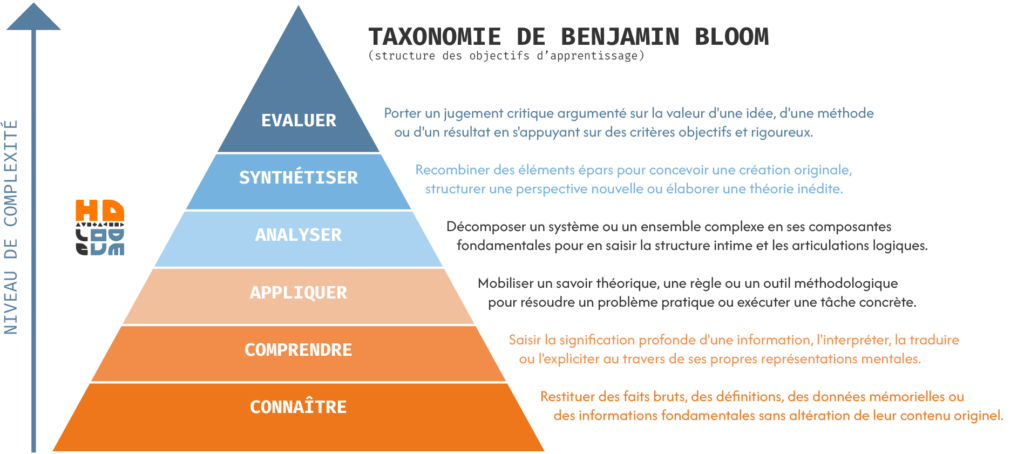
While this model remains a valuable benchmark in pedagogy, contemporary research in cognitive psychology, didactics, and neuroscience encourages a more nuanced reading than this linear framework. The human brain does not progress in a strictly hierarchical or compartmentalized manner. Learning proves to be an eminently iterative and multifaceted process, wherein the mind can grasp a concept through practical experimentation, intuition, or deconstruction long before formalizing its academic theory.
While the major stages of thought remain universal, how can we explain why uniform teaching methods so often prove inefficient? Through what unique paths, contexts, and specific modalities does each individual truly come to integrate knowledge?
The Uniqueness of Cognitive Paths and the Question of Motivation
It appears evident that learning failure or difficulty rarely stems from an intellectual deficit, but almost always from a mismatch between the imposed method and the individual’s specific mode of cognitive processing. At the heart of this equation lies a universal engine that is all too often overlooked: motivation.
In psychology, motivation is traditionally split into two main axes:
Extrinsic motivation, governed by external stimuli, rewards, or social validation.
Intrinsic motivation, driven by pure curiosity, a sense of autonomy, and the pursuit of mastery.
Yet, beyond these broad classifications, personal experience demonstrates that the drive to learn responds to far deeper, visceral, or energetic triggers.
What if the key to our ideal learning trajectory lay in the deepest reaches of our internal architecture?
Without claiming to erect an absolute dogma—for every model is merely a perspective offered for personal reflection—it is fascinating to explore how the major paradigms of education and the drivers of motivation find a striking echo in the intimate mechanics of the individual, as certain energetic frameworks, such as Human Design, invite us to observe.
Exploring the 5 Major Educational Paradigms
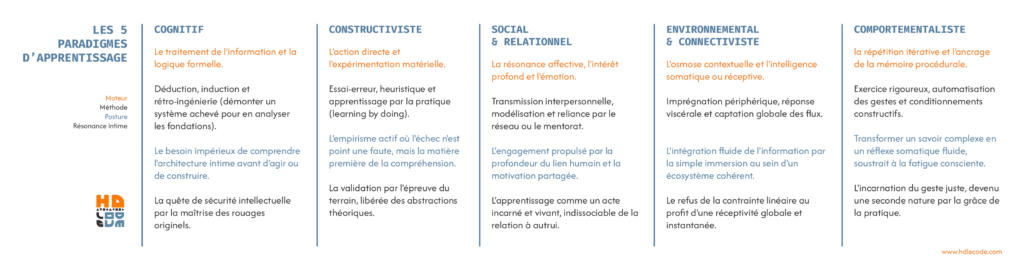
Cognitive
Constructivist
Social & Relational
Environmental & Connectivist
Behaviorist
1. The Cognitive Paradigm and Analytical Deconstruction
This movement views the mind as a highly sophisticated information processor. It encompasses deductive and inductive learning (moving from an observation to a proposition that accounts for it), with reverse engineering being its purest illustration: the art of dismantling a finished system to understand its innermost structure.

A singular echo with Human Design: this cognitive paradigm reflects the imperative need to dissect foundations before taking action. This may manifest in profiles marked by Line 1, the Investigator (profiles 5/1, 4/1, 1/4, 1/3). For these individuals, intellectual security demands mastering the smallest cogs of the subject under study; building or moving forward without having first explored the genesis and structural solidity of the system is nearly impossible for them.
2. The Constructivist Paradigm and Heuristic Empiricism
Here, knowledge is by no means passively transmitted; it is forged through action, direct engagement with reality, complex problem-solving, and the trial-and-error cycle. The learner constructs their knowledge through continuous manipulation and experimentation.
A singular echo with Human Design: this active empiricism embodies the signature of profiles possessing Line 3, the Martyr (profiles 6/3, 3/5, 3/6, 1/3). Lacking patience for abstract theories or rigid manuals, they validate knowledge through real-world experience. Error constitutes no failure for them, but rather the essential raw material of their empirical understanding.

3. The Social, Relational Paradigm and the Dynamics of Motivation
This approach posits that intelligence flourishes in otherness, networks, interpersonal transmission, and affective resonance. Learning is never a clinical act: it is propelled by emotional engagement, deep interest, or attachment to a « mentor. »
In relation to Human Design, a striking anchor emerges here through the mechanics of the Solar Plexus, the Ego (Heart), and Line 4, the Opportunist:
- The Solar Plexus and the pursuit of depth: learning here is inseparable from the emotional wave and passion. The individual fully commits only when experiencing an intense affective resonance with the subject matter, with clarity emerging not through haste, but through moving through emotional depth.
- The Ego and personal willpower: motivation can draw its source from personal willpower, the desire for self-achievement, or conscious commitment, acting as a powerful fuel to overcome learning obstacles.
- Line 4 of the Opportunist and the network: in this perspective, this profile (4/1, 4/6, 2/4, 1/4) possesses the organic capacity to learn through their inner circle, relationships, and the interpersonal transmission system. Human connection and mentorship serve as indispensable vehicles of competence.

4. The Environmental, Connectivist Paradigm and the Sacral Response
In the era of complexity, learning can occur through osmosis, peripheral and unfocused immersion within a coherent ecosystem, or through the sudden emergence of internal resonance when facing information.
The singular echo of this mode of acquisition within Human Design connects to the Sacral and receptive variables (right-facing arrows):
- The Sacral response: at times inexplicably, this motor center can suddenly ignite upon hearing a specific topic, triggering an irrepressible research drive that propels the mind into passionate learning, guided by bodily intelligence rather than a mental decision.
- Receptive variables: seeking to impose linear memorization and focused attentional effort upon receptive minds often constitutes a sterile constraint. Their mind operates instead like a global vessel that integrates information through impregnation, much like an observer soaking in the beauty, structure, and coherence of a visual object without having to decode every line in a didactic manner.
5. The Behaviorist Paradigm, Procedural Anchoring, and the Nuance of Conditioning
This movement underpins the acquisition of physical automatisms and procedural memory through repetition and rigorous practice. Procedural memory is an implicit form of long-term memory that allows skills, motor abilities, and habits to be acquired and stored without conscious effort.
Consider a child born into a family of winemakers: the child reads no enology manuals but grows up in the heart of an environment where stimuli endlessly repeat with the passing seasons. Year after year, they observe their parents’ gestures, touch the soil, inhale the cellar aromas, and listen to the sounds of fermentation. Through continuous reinforcement and daily exposure, their nervous system registers sensory micro-details imperceptible to a novice. As an adult, they will instinctively recognize grape maturity or the exact moment for a vintage, not through complex mathematical reasoning, but through a perceptive and procedural reflex anchored deep within their physiology. The gesture and discernment have become second nature, entirely freeing their conscious mind.

A singular echo with Human Design: this paradigm particularly speaks to structures that require integrating know-how through mechanical repetition and rigorous practice, allowing the body and nervous system to transform complex information into a fluid, unconscious reflex.
Several elements of the bodygraph belong to this instinct, this somatic intelligence, and the embodied reflex, including:
- The Integration Circuit formed by channels 20-57, 10-34, and 10-57,
- Gate 16 of Skills and, by extension, the Channel of Talent (16-48),
- The 3 Format Channels connecting the Root to the Sacral (42-53, 3-60, and 9-52).
Regarding the behaviorist paradigm, I would nevertheless offer a perspective: while energetic readings often emphasize the necessity of deconditioning, it should be approached with nuance. Not all conditioning is harmful or alienating: social structures, constructive routines, and organizing habits greatly facilitate our navigation through the complexity of existence. Much like a therapeutic process, the goal is not to design a perfect being or strip away every acquired rule, but rather to develop discernment. It is simply a matter of identifying what hinders our full expression and generates suffering, as opposed to what eases our lives and respects our integrity.
Summary of the 5 Learning Paradigms
Toward an Ecology of Knowledge
While seeking a single, universal learning method remains illusory, cross-exploring these different paradigms and their intimate resonances offers a profoundly liberating perspective. Whether deconstructing a system through analytical necessity, engaging directly with matter through empiricism, absorbing a visual environment, following the surge of a deep resonance, or anchoring a gesture through repetition, every mind obeys a geometry entirely its own.
The true ecology of knowledge lies therefore not in blind submission to a standardized model, but in the cultivation of intimate discernment. By truly listening to oneself to perceive what resonates as true, each individual can break free from sterile constraints to shape a way of learning and living that honors them while respecting others.