
How do humans learn, integrate, and digest information? The acquisition of knowledge is a complex process for which there are countless analytical frameworks. I would like to discuss two approaches in particular that shed light on each other, although many others obviously exist: the cognitive view from modern neuroscience, and the energetic reading from the variables (Primary Health System) in Human Design.
A particularly accurate definition of intelligence views it as the ability to make connections. Learning is not simply storing data in an empty box; it is creating new bridges within ourselves, connecting ideas that seemed distant, and allowing our mind to weave its own web of understanding.
The neuroscience reading: attention and brain plasticity
At the heart of our ability to make these connections lies a biological phenomenon: neuroplasticity. This is our brain’s capacity to modify itself and strengthen communication circuits based on our experiences.
To simplify, our nerve cells (neurons) communicate with each other through contact zones. Learning a new movement or a new concept is like forging a trail in a dense forest. The more we repeat the information, the smoother the communication between these cells becomes: the initial trail turns into a superhighway of connection.

The four keys to learning
For the brain to agree to forge these new paths, cognitive science research, notably illustrated by the work of Stanislas Dehaene, shows that it needs four essential factors:
1. Focused attention:
This is our brain’s spotlight. Without attention, information slips away without leaving a trace.
2. Active engagement:
We do not learn by remaining passive. The mind must test, rephrase, and manipulate the concept for connections to be made.
3. Error feedback (without judgment):
The brain learns by making mistakes. It is by noting the gap between its prediction and reality that it adjusts its circuits. Error is the biological signal essential for course correction.
4. Rest and consolidation:
It is primarily during sleep that the brain sorts and engraves what is essential into long-term memory.
The ultimate engine: interest and age
This learning mechanism evolves over time. In children, the brain is in a phase of maximum plasticity: it absorbs everything almost effortlessly. In adults, learning requires a voluntary effort and demands more energy. But beyond age, it is interest that governs attention.
We have all experienced this: remember middle school, when you were forced to memorize historical dates you couldn’t care less about. The effort was monumental, almost painful, because the brain was fighting against constraint. Conversely, when you discover a subject you are passionate about as an adult, like Human Design, your attention is multiplied tenfold. Assimilation becomes fluid, almost easy.
Personal interest is the fuel for our neural connections.
Everyone is perfectly capable of learning, but it simply demands more or less effort and energy depending on the individual. This variability regarding effort is the perfect transition to understand how Human Design maps our individual differences.
The Human Design reading: cognitive digestion in the variables (PHS)
Human Design approaches learning from a unique angle through the variables (the 4 arrows located at the top of the bodygraph). The bottom-left arrow is the key to the PHS (Primary Health System): it does not only define what you eat, but how your mind assimilates information.
The origins of PHS: between traditions and genetics
PHS is based on a biological analogy: our brain (mind) digests information exactly as our body digests food. If your conditions for assimilation are not respected, your ability to make connections collapses or depletes, generating fatigue or mental confusion.
The system is structured with microscopic precision, derived from the 64 hexagrams of the I Ching:
- each gate contains 6 Lines,
- each line contains 6 colors,
- and each color contains 6 tones.
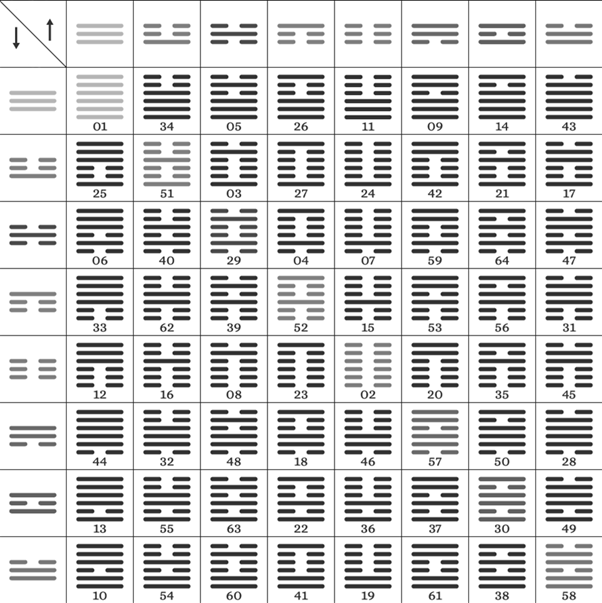
Although the term “PHS” is specific to Human Design, its fundamental philosophy—which holds that the body and mind mirror each other—resonates with very ancient wisdom:
In Traditional Chinese Medicine, the assimilation of food and the digestion of thoughts are governed by the same energetic movement (the Earth element, linked to the spleen and stomach).
In Ayurveda, the health of the mind depends directly on the Digestive Fire (Agni). If one does not digest their food well according to their constitution, the mind becomes clouded.
PHS relies on this exact same observation: our mind digests information in the same way our body digests food. If our conditions of assimilation are not met, our ability to make connections breaks down.
The mechanics of PHS: colors and tones
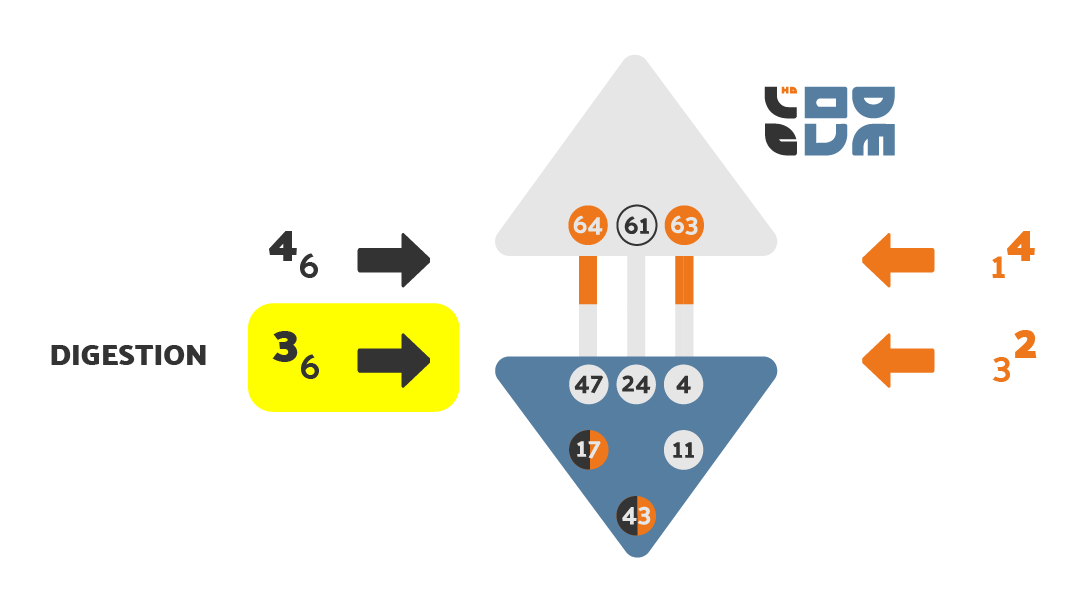
The 6 colors: the different modes of assimilation
The color defines your external “mode of assimilation” (the ideal conditions for learning) or the ideal circumstances we must be in to absorb information:
Color 1: Appetite / The Hunter
Information must be processed sequentially—one subject at a time, without conflating distinct themes.
Color 2: Taste / The Fridge
Selective digestion: The mind requires containment within highly restricted domains, pre-selected by a well-defined inclination.
Color 3: Thirst / The Raw
The mind operates through alternation (hot/cold). It necessitates either a dynamic and constant influx of information, or a profoundly serene, analytical approach.
Color 4: Touch / Low-Fat
The environment must be minimalist. The mind assimilates information far more effectively in a tranquil setting, devoid of external interference.
Color 5: Sound (Acoustic Level) / High-Fat
Integration is regulated by the acoustic environment: you require a specific auditory threshold—be it ambient background noise or absolute silence—to “nourish” the brain.
Color 6: Light / The Selective
Light dictates digestion. Learning is optimized either during hours of direct luminosity (daylight) or within a muted, nocturnal atmosphere (nighttime).
The 6 Tones: sensory orientation
Tone serves as your internal compass. It indicates the primary sense through which your system perceives reality:
Tone 1: Smell
A need for olfactory security and familiar landmarks to feel prepared for assimilation.
Tone 2: Taste
An intuitive capacity to test, sort, and immediately discard that which is not intellectually nourishing.
Tone 3: Outer Vision
Assimilation through the active observation of structures, details, and the physical environment.
Tone 4: Inner Vision
Assimilation through mental visualization, imagination, and internal reflection.
Tone 5: Feeling
Sensitive assimilation, highly receptive to vibrations and the energetic ambiance of a space.
Tone 6: Touch
Integration through physical experience, movement, and contact with material reality.
Interpreting the arrow and identifying your variable
To identify your digestion variable, observe the arrow located at the bottom left of your bodygraph:
The direction of the arrow
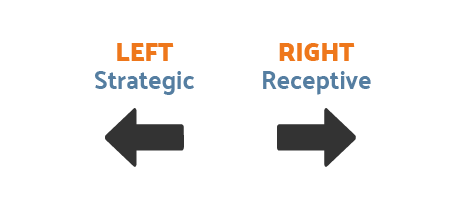
If the arrow points to the LEFT: Your system is considered “strategic.” You learn in a linear, planned manner, utilizing a focused approach.
If the arrow points to the RIGHT: Your system is considered “receptive.” You learn through immersion, without conscious effort, using a peripheral approach.
Identifying your variable
To accurately identify your variable (e.g., “Color 3, Tone 6”), refer to the numbers associated with this arrow in your chart data (frequently listed beneath the diagram):
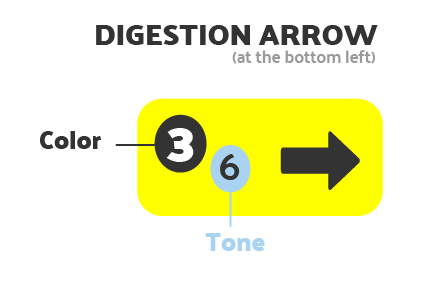
Example: If the reading on your arrow is 3.6, your digestion corresponds to Color 3 (Thirst) with a Tone 6 orientation (Touch). You assimilate information through alternation (hot/cold) while intuitively sorting what serves you.
Note: This data can be found within the technical specifications of your Human Design calculation. If only the arrow is visible on the diagram, please refer to the “Design” or “Personality” table of your report to locate the precise digits corresponding to your PHS arrow.
Somatic integration: when form sustains the mind
Because learning cannot be reduced to mere mental willpower or forced memorization, alternative, gentler, and complementary pathways exist to anchor knowledge: somatic and visual integration.
Somatic integration consists of channeling intellectual information down into the physical body. Rather than exhausting the brain through linear repetition, this approach utilizes passive visual exposure.
Our visual cortex is capable of processing shapes, colors, and geometries in the background, without requiring our direct, conscious attention. By displaying a chart or a graphic diagram within our living or working space, for instance:
We stimulate passive memory:
The brain records the graphic structure while we attend to our daily activities;
We forge unconscious connections:
By repeatedly glancing at this form at various intervals throughout the day, the nervous system becomes accustomed to the diagram and begins to integrate it naturally;
We facilitate anchoring:
The mind no longer needs to “think” about a rule; it simply begins to experience its resonance fluidly, at a corporeal level.
Visual integration does not substitute for experience or experimentation; rather, it acts as a benevolent support mechanism, preparing the neurological terrain so that the seed of knowledge may take root without resistance.
And what about you: in what manner do you prefer to integrate new knowledge? Do you require complete isolation to digest information, or do you learn more effectively by observing visual structures? Please share your learning experiences in the comments below!